


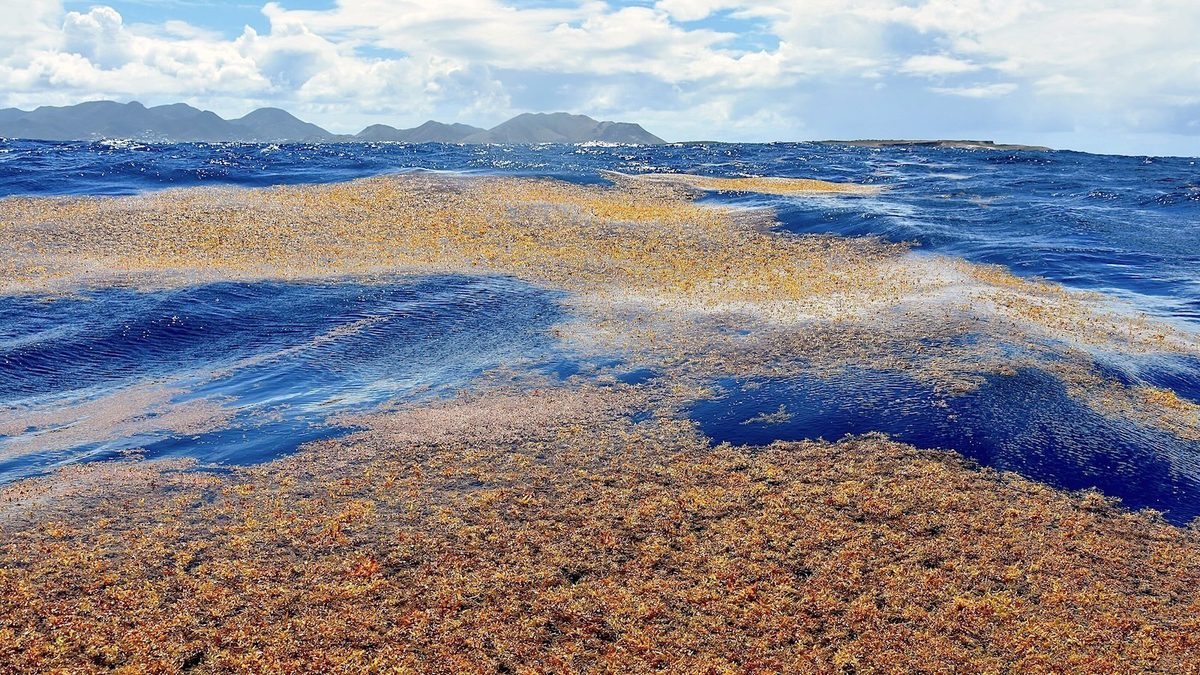
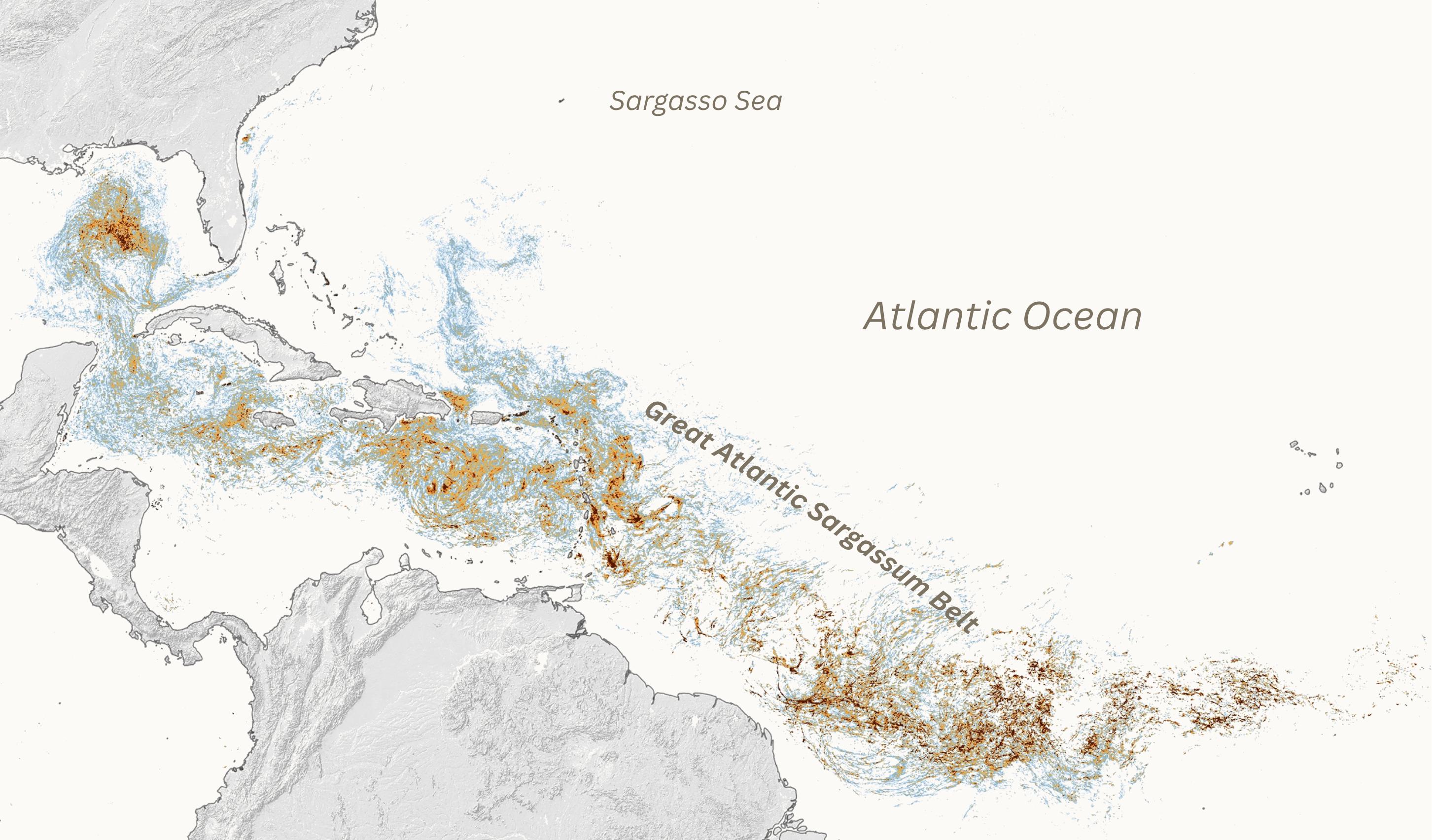
Many of America’s favorite beaches in Florida and the Caribbean have been piled high with foul-smelling seaweed again this summer, often in record amounts. What disappointed tourists may not know is that the inundations, which also smother coral reefs, mangroves, and sea grasses, are just the most visible sign of a vast new marine ecosystem — an expanse of floating sargassum that since 2011 has seemingly come from nowhere to spread in a 5,500-mile-long belt from Mexico to West Africa and Florida to Brazil.
The dense mats of offshore weed grow up to 20 feet thick, and this summer reached a record weight of 38 million metric tons — more than the total weight of all Americans.
The seaweed scourge is wrecking coastal economies in countries heavily dependent on tourism and fishing. The coastlines of 30 countries across the Caribbean and beyond are being visited by the brown mats piling up on beaches, where the weed decomposes, releasing gases such as hydrogen sulfide, with its distinctive rotten-egg smell, and ammonia, which trigger asthma attacks and exacerbate other respiratory conditions. Thousands of victims have been reported by doctors in the Caribbean, especially among workers clearing beaches.
The tropical sargassum belt now forms “the largest interconnected floating biome on Earth,” says an ecologist.
The weed also blocks water intakes and prevents
The weed also blocks water intakes and prevents fishers from taking their boats to sea, as well as clogging their nets, engines, and propellers. It has caused mass deaths of marine life on coastlines, while preventing sea turtles from laying their eggs on beaches and blocking hatchlings trying to return to the ocean. The weed also accumulates heavy metals such as arsenic, which leaches out as the weed decomposes on land and can poison water supplies.
For such reasons, most ecologists regard the belt as a menace.
But, while acknowledging its onshore harms, some researchers are now recognizing the Great Atlantic Sargassum Belt as a significant new habitat for marine life in the open ocean, and a valuable carbon sink for the planet. According to Jonathan Jung, a marine ecologist at the Max Planck Institute for Chemistry in Mainz, Germany, the weed and its growing army of inhabitants now form “the largest interconnected floating biome on Earth.”
Sargassum seaweed in the Atlantic was once mostly confined to the Sargasso Sea, an area of sluggish waters off Bermuda largely cut off from the rest of the ocean by rotating ocean currents. It has been well-known to mariners since Christopher Columbus reported sailing through “so much grass that it looked like the sea was curdled with it.” A vital nursery for fish and turtles, the sea is now confirmed to be the breeding and spawning ground of both American and European eels.
NASA / Adapted by Yale Environment 360
In 2011, weed from the Sargasso Sea abruptly
But in 2011, weed from the Sargasso Sea abruptly spread south, driven by anomalous winds generated by an unusually long negative phase of an atmospheric cycle known as the North Atlantic Oscillation, or NAO, in which changes in relative air pressure in the Atlantic alter wind directions. The floating mass was then sustained by upwelling nitrogen and phosphorus. These nutrients usually lurk at depths below a thousand feet but were brought to the surface by ocean mixing created by the unusual winds.
The belt of weed swiftly spread across huge swaths of the tropical Atlantic. And there it has stayed, despite the end of the NAO anomaly and the abnormal ocean mixing.
Many mechanisms have been proposed for this unexpected persistence. Perhaps deforestation along the path of the two great rivers flowing into the tropical Atlantic — the Amazon in Brazil and the Congo in Africa — provides a continuous flush of nutrients from soils. Saharan dust is another potential source.
In a paper published in April, Annalisa Bracco,
But in a paper published in April, Annalisa Bracco, an oceanographer at the CMCC Foundation, a research center in Milan, and colleagues modeled nutrient flows in the ocean and concluded that such theories did not fit either nutrient fluxes or the timing of events. Instead, their modeling showed how the rich ecosystem that swiftly developed around the sargassum continuously recycles the nutrients originally brought to the surface by the mixing.
NOAA has designated parts of the tropical sargassum belt as “essential fish habitat” and “critical habitat” for loggerhead turtles.
“The ecosystem is now feeding on itself,” Bracco says. The belt “is a striking example of how the ocean can reorganize itself very quickly. What started as a wind-driven event has become a self-sustaining biological system.”
Scientists remain divided about whether climate change played a role in the belt’s emergence. Some climate models suggest a warmer world is pushing the NAO to more extreme phases, such as those in 2010 and 2011. In any case, it is likely that ocean temperatures will matter in the future. Optimal sea temperatures for sargassum growth are around 79 degrees F, but temperatures above 86 degrees F can hinder growth. Average sea-surface temperatures in the tropical Atlantic currently range between 81 and 85 degrees F. “Ultimately, the future of sargassum in the tropical Atlantic will depend on… global warming,” argues Alfredo Martínez-Garcia, a geochemist at the Max Planck Institute for Chemistry. So future warming could ultimately doom the tropical sargassum.
Even so, what has happened in the past
Even so, what has happened in the past 15 years appears unprecedented. There are records of seaweed blooms in the Gulf of Mexico during the Mayan civilization a millennium ago, but they were far smaller and less prevalent. “There is nothing like [today’s vast bloom] in these latitudes anywhere in the historical records,” says Bracco.
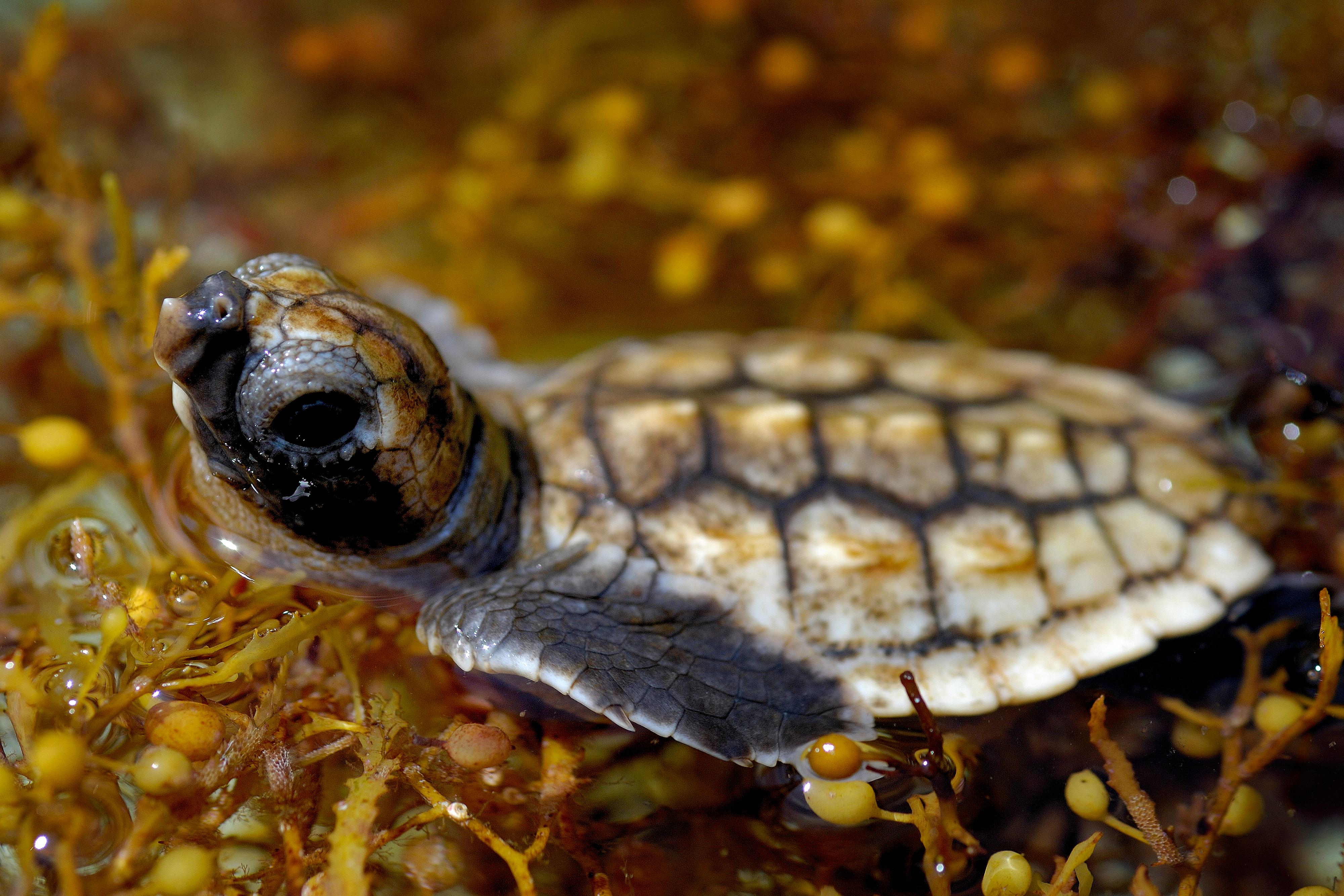
There are many species of sargassum, some found in the Pacific Ocean and elsewhere. But while most cling to the seabed, it is the floating species Sargassum fluitans and Sargassum natans that predominate in the Atlantic. While the ecosystem they have created in the Sargasso Sea is well-researched, to date, very little research has been done on the make-up of this new Atlantic biome. But it is very different from the previously clear ocean it has replaced, which had a low supply of nutrients, limiting marine life. Today, numerous species live on the leaves, stems, and air bladders of the floating sargassum, including bacteria and other algae supporting populations of invertebrates such as crabs and shrimp, seabirds, and the endemic predatory sargassum fish. Some species are common to sargassum, while others are specific to the warmer tropical waters where the seaweed belt has formed.
The sargassum also helps maintain wider tropical marine ecosystems by providing shelter for juvenile fish species, as well as new habitat for endangered loggerhead and green turtles, and food for larger fish. It “acts as a floating ecosystem for marine life, providing essential food and shelter for important species, such as tuna, marlin, turtles, and birds,” according to an international study led by Jung last year.
As the new ecosystem develops, it is causing
As the new ecosystem develops, it is causing scientists to reassess the invasive sargassum. Despite the damage it causes when inundating shores, a growing band of enthusiasts says that it should be celebrated and not condemned. Just as there are international calls led by Greenpeace, the IUCN, and the Bermuda and U.K. governments to designate the long-standing sargassum mats in the Sargasso Sea as a marine sanctuary under the U.N. High Sea Treaty, so some ocean scientists would like the same protection accorded to its giant new offspring.
Efforts to collect sargassum encroaching on beaches have fueled interest in finding uses for the harvested seaweed.
Researchers at NOAA have already spoken up for the importance of the new sargassum biome. They have designated areas of the tropical sargassum belt in the waters of the Gulf of Mexico and U.S. Caribbean as “essential fish habitat” and “critical habitat” for loggerhead turtles under the Endangered Species Act. To protect this habitat, NOAA currently prohibits the commercial harvest of sargassum in all U.S. federal waters south of North Carolina.
Blooms of sargassum in the tropical Atlantic peak in September on the African coast and in July in the west, where Mexico currently spends more than $300 million annually cleaning up the mess. More than 500 workers in protective gear have this year picked up more than 100,000 metric tons of sargassum weed from the beaches of the southeastern state of Quintana Roo.
The state boasts that its famous resort cities
The state boasts that its famous resort cities such as Cancun, Tulum, and Playa del Carmen offer palm-lined white sandy beaches and coral reefs. But for much of the year, those beaches and reefs are often smothered by piles of brown seaweed that float ashore each day on the tides. Hotels are emptying as spooked tourists look instead to the country’s Pacific coast.
In July, at the height of the current infestation, the Mexican government announced emergency measures to fight the menace, including deploying 30 miles of containment barriers to intercept mats before they reach land and buying amphibious weed harvesters to patrol offshore.
Efforts to collect encroaching sargassum have fueled interest in finding economic value for the harvested weed, especially now that modelers say they can predict sargassum hotspots up to seven months ahead, opening up the prospect of cost-effective harvesting.
Plans include converting the weed into biofuel
Plans include converting the weed into biofuel or fertilizer, or using it as an organic replacement for cement in construction. Start-ups are keen to join in. Carbonwave, a sargassum refining company launched in 2020 in Boston but operating in Mexico and Puerto Rico, extracts biopolymers to make textiles, plastic, and emulsifiers.
The weed could also be harvested to capture its carbon and sell carbon credits. “Sargassum absorbs large amounts of carbon dioxide as it grows,” says Bracco. Its dry weight is 30 percent carbon. “When it reaches the coast and decomposes, much of that carbon is released back into the atmosphere. If we can intervene before this happens, this system could instead be part of the solution [to climate change].”
Sargassum seaweed can be “a source of jobs, innovation, and even clean energy,” says an E.U. commissioner.
But care must be taken, says Danielle Hatt, a marine ecologist at Florida International University, in a study for the French territory of Guadeloupe, one of the most affected Caribbean islands. “Chemical screening for toxic metals, particularly arsenic, should be mandatory before approving the use of sargassum biomass for agricultural, food, or feed applications,” she says.
Many ideas for using sargassum will be discussed
Many ideas for using sargassum will be discussed at an international conference on sargassum exploitation, organized with the European Union, in Cancun in October. Hopes are high. “This crisis can be turned into an opportunity — a — by building value chains from sargassum,” says Jozef Síkela, E.U. Commissioner for International Partnerships
But whatever the commercial rationale, few believe that offshore harvesting will ever eradicate the weed. “To stop it self-sustaining, you would have to collect most of it — many millions of tons. Most of the bloom is not nearshore. It is in remote parts of the ocean where people don’t and won’t be able to harvest it,” says Bracco.
There could, in other words, be a policy sweet spot, in which beaches and coastal ecosystems are protected by commercially sustainable harvesting, while the species-sheltering belt in the open ocean persists.
